Who owns the quantities? BIM cost estimating in Europe and Japan

BIM cost estimating is gaining ground in both Europe and Japan, but the two regions start from different places. What separates them is not technology. It is the answer to a simple question: who is responsible for the quantities?

In this article, we compare the two models on five points: what drives BIM adoption, who controls cost, how cost is tracked through the project, what the two regions share, and what each can learn from the other.

The comparison draws on our meetings with general contractors and estimating specialists in Japan in October 2026.


No time to read it all?

Europe gives the quantities to an independent professional and pushes BIM through public procurement, while Japan leaves them with the contractor and pushes BIM through building permits, and each would gain from borrowing from the other.

Why the question is becoming urgent in Japan ?


For three decades, Japanese builders barely had to think about price escalation. Deflation kept materials and labour flat, and a budget set at the start of a project usually held to the end. That period is over. In March 2024 the Bank of Japan raised rates for the first time in 17 years, declaring the long deflationary era over.


Construction is where the change hits hardest. Turner & Townsend expects construction costs to rise 5.6% in 2025 and another 5.3% in 2026. Site wages have climbed 23% since 2021, and a weaker yen has made imported materials more expensive. In the consultancy’s survey, every general contractor said cost had forced projects to be delayed or cancelled. The industry rarely had to manage inflation before. Now it has to re-estimate quickly and often, and that is exactly what BIM cost estimating, with quantities taken straight from the model, is meant to make easier.


Two routes to BIM: public tenders in Europe, building permits in Japan


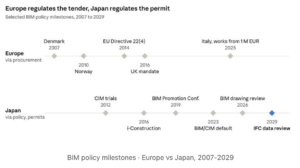
In Europe, BIM spread from the client side. Article 22(4) of Directive 2014/24/EU allows Member States to require “specific electronic tools”, BIM among them, for public works. Each country then set its own timetable: Denmark in 2007, Norway in 2010, the UK in 2016, and Italy in January 2025 for public works worth €1 million or more. Some countries, Belgium among them, still have no national mandate. There, the industry drives adoption from the bottom up, and Buildwise, the research and innovation centre funded by Belgian contractors, plays a central role.


What holds this patchwork together is a shared technical base: EN ISO 19650 for information management and IFC for data exchange. In its November 2025 position paper, the EU BIM Task Group calls for “a common baseline, not the same rules for everyone”. It cites lifecycle savings of 10 to 20%, most of them from avoiding unplanned costs.


Japan took a centralised route. The Ministry of Land, Infrastructure, Transport and Tourism (MLIT) has made BIM/CIM standard practice for public civil engineering works, except small projects, since FY2023. For buildings, the government uses the permit process as its lever. Since April 2026, applicants can submit drawings generated from BIM for building confirmation. From spring 2029, examiners will review the IFC model data directly.


The programme is coordinated by the Building BIM Promotion Conference, a public-private body created in 2019 that includes a working group on cost estimating. The EU has no direct equivalent: there, cost management is left to national professions and standards.


Chronologie des politiques BIM

[Figure: BIM policy timeline, 2007–2029. Europe’s mandates arrive country by country through procurement. Japan’s come from a single ministry and lead to model-based permit checks.]

The real divide: who is responsible for cost


Dans une grande partie de l’Europe, un professionnel indépendant gère les coûts pour le compte du maître d’ouvrage : le quantity surveyor au Royaume-Uni et en Irlande, l’économiste de la construction en France. En Belgique et en Allemagne, l’estimation des coûts en début de projet fait partie de la mission de l’architecte. Chaque pays a ses propres règles de métré, comme les normes RICS NRM1 pour l’estimation des coûts, NRM2 pour le métré détaillé et NRM3 pour la maintenance, ou les groupes de coûts de la DIN 276.


Across much of Europe, an independent professional manages cost on the client’s behalf: the quantity surveyor in the UK and Ireland, the économiste de la construction in France. In Belgium and Germany, early cost planning is part of the architect’s role. Each country has its own measurement rules, such as RICS NRM1 for cost planning, NRM2 for detailed measurement and NRM3 for maintenance, or the DIN 276 cost groups.


In the traditional European tender, the client’s team measures the design and publishes a bill of quantities. Every bidder prices the same list, so bids can be compared line by line. BIM’s promise in that setting is clear: generate the bill directly from the model.

In Japan, cost expertise sits inside the contractor. Each of the five largest firms (Kajima, Obayashi, Shimizu, Taisei and Takenaka) employs thousands of registered architects in its own design department. Lump-sum contracts are the norm, so the contractor owns the estimate, the purchasing and the risk. Independent sekisan (estimating) firms and certified building cost estimators do exist. They work mainly on public projects, which are measured to MLIT’s Standard Method of Measurement for Public Building Works.


The timing differs too. As Tatsuya Nakamura explains in BIM in Japan, part 3: project transparency, Japanese general contractors are often asked to price a design at a low level of development (LOD), much earlier than a European bidder would see it. Once the price is agreed, the contractor’s seisan sekkei (production design) team develops the drawings to construction level. Designer and builder don’t have to be separate companies: roughly half of the building work done by Japan’s 23 largest contractors is design-build.


This shapes what each side wants from a model. A European quantity surveyor needs a model that someone outside the design team can measure with confidence. A Japanese contractor needs a model that feeds its own estimating, procurement and site systems without leaving the company.


Europe’s separation of roles has a side benefit for BIM. In many countries the designer must stay independent of the builder. In Belgium, the 1939 law on the architectural profession makes being an architect incompatible with being a contractor. Projects therefore rest on a three-way relationship. The designer validates technical choices, the client approves every change, and the contractor has to keep both informed. When information has to cross company lines all the time to get approved, an open, shared model is the obvious way to exchange it. That built-in need to coordinate helps push adoption forward.


Following cost through the project


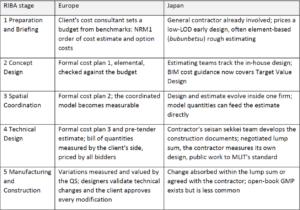
Both regions estimate cost in roughly the same order, but responsibility changes hands at different points. The table below follows RIBA Plan of Work stages 1 to 5, which RICS NRM1 links to its successive cost estimates and cost plans. In Japan, most of these steps happen inside a single contractor.


Gestion des gouts par phase de projet

[Table: cost management by project stage, Europe vs Japan]


After Stage 5, NRM3 covers maintenance costs, and European public clients increasingly ask for life-cycle costing and LCA. In Japan, the IFC data submitted for permits will be reused for inspections from 2029.


What BIM really speeds up is each iteration. In an MLIT-funded pilot, most model-based quantities came within 3% of a manual take-off to the public standard, and cost work could start about a month earlier. That cut the estimating phase by 25%. The same pilot found that 44 of the 159 finish items needed custom Revit families before they could be measured. Any European QS who has tried to quantify a native model will know that problem.

Common ground


The two regions have more in common than their cultural differences suggest.

  1. A model is not a measurement. The Japanese pilot traced most discrepancies to measurement rules, for example not deducting openings of 0.5 m² or smaller. NRM2 and other European methods have similar conventions. The model supplies the geometry; the measurement standard turns it into a bill.
  2. Classification is the weak link. Japan’s BIM cost working group is trialling a Japanese version of Uniclass to code elements consistently. Europe has the same fragmentation across Uniclass, CCI, OmniClass and national systems.
  3. Open standards are the shared answer. Japan’s 2029 permit checks will run on IFC. European public clients write IFC and ISO 19650 into their tenders.
  4. Productivity pressure now drives both. Workforces are ageing and labour is short on both sides, so manual take-off is becoming a scarce skill. Japan’s i-Construction programme aimed for a 20% productivity gain by 2025.
  5. People still sign off. MLIT has ruled out fully automated, AI-only permit checks for now. European cost professionals likewise remain accountable for their figures.


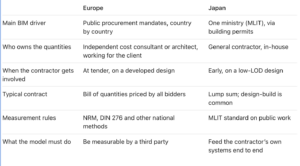
Key contrasts

 fundamental difference is structural. Europe keeps design, cost and construction in separate hands. Japan brings them together, and most communication happens inside the contractor rather than with the client.


FR Japan EN

Lessons for both sides


  • Europe: use regulation to raise model quality. From 2029, Japan will check permit applications against IFC data, which forces quality at the source. A model reliable enough for a building inspector is generally reliable enough for a quantity surveyor.
  • Europe: shorten the cost feedback loop. When one organisation designs, estimates and builds, designers hear about cost within days instead of waiting for the tender. Two-stage tendering and early contractor involvement deliver much of that benefit while keeping independence.
  • Japan: adopt shared measurement. A published bill of quantities lets clients compare bids and track changes openly. The cost working group’s interest in Uniclass is a first step. Open, rule-based measurement from IFC could extend it to private projects.
  • Both: invest in the translation layer. The weak point is rarely the model or the estimator. It is the link between them: classification, measurement rules, and a clear trace from every object to every line of the bill. That is where the next gains in cost certainty will come from, in Brussels and in Tokyo alike.